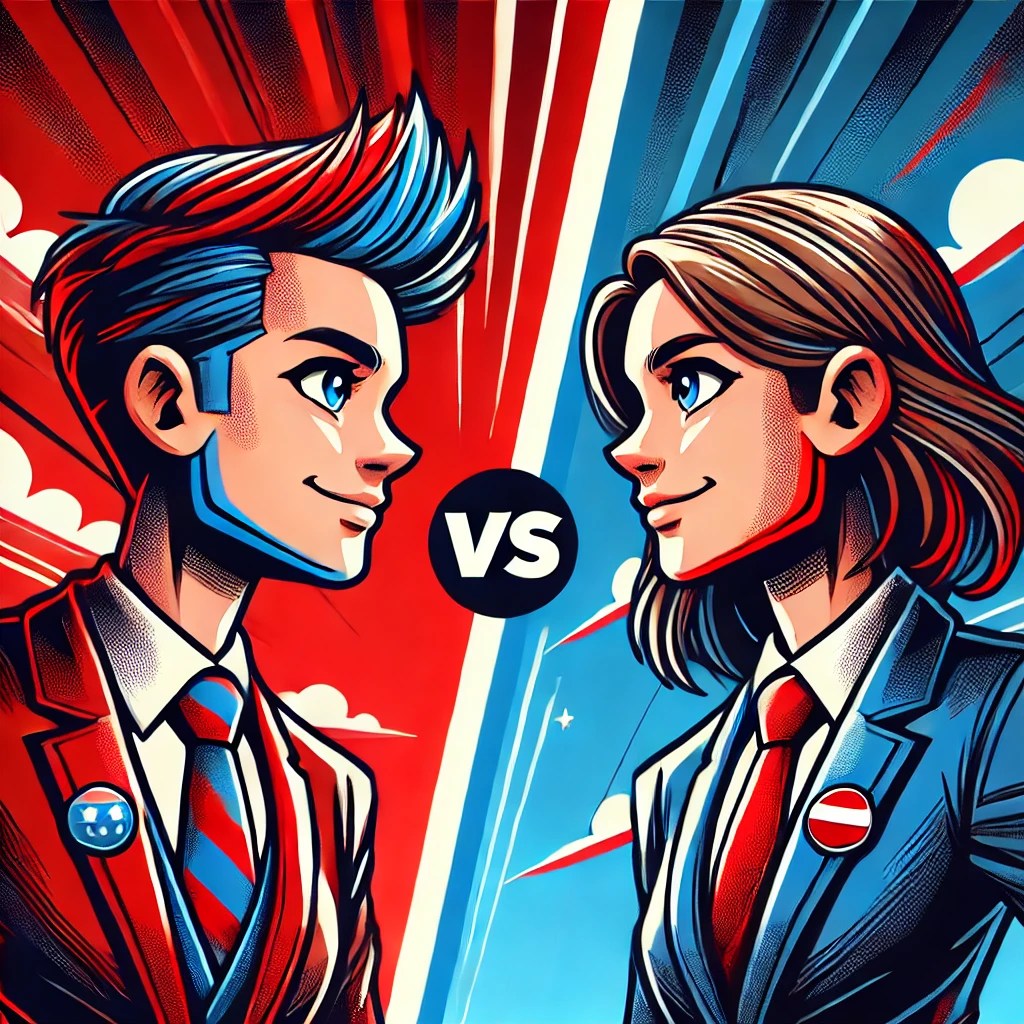
It’s that time again in America where people head out to the ballot boxes, or should I say voting machines, to have their say on who will be the future president. I’m not interested in UK politics, never mind American politics, but since I was writing this I made an effort to do a little research surrounding the topic. For those who are like me and aren’t fully clued up it’s pretty much the same as UK politics. On the one hand, you’ve got the Democratic Party headed by Kamala Harris, who is the American equivalent of our Labour Party headed by Kier Starmer. On the other hand, you’ve got the Republican Party, headed by Donald Trump, of which our British Equivalent is the Conservative Party headed by Rishi Sunak.
Of course, each political party has its own opinions on how things should be done. The Democratic Party generally supports progressive policies such as social justice, environmental protection, healthcare reform, and expanded social programs. They favor more government intervention in the economy and advocate for strong public services such as education and healthcare. In contrast, the Republican Party generally supports conservative policies, including limited government, free market capitalism, lower taxes, and strong national defenses. For example, where the Democratic Party would want to bring healthcare under public ownership, the Republican Party would push for privatization.
The life of a politician, particularly one running for president, is a strange thing. Their number one is aim is merely to win over as many people to their side and amass the most votes. As a result, they decide which social issues people are interested in and take a stance on such issues. Kamala and Trump have both taken stances on a wide range of social topics. On some topics, their motives seem to be aligned. Harris has promised that from day one her priority is to reduce inflation; and likewise, Trump has also promised to “end inflation and make America affordable again”. On others, they disagree or promote the opposite policies from one another. For example, Harris wants to raise taxes on big businesses and Americans making over $400,000, as well as increasing capital gains tax from 23.6% to 28%. Conversely, Trump wants to implement a number of tax cuts worth trillions.
People are presented with these topics of conversation, form opinions on them, and then pick and choose a so-called side of the political spectrum to align themselves to. For example, if you care a lot about lowering immigration numbers you’d probably vote for Trump over Harris. Whereas if you care more about ensuring Ukraine receives more support you’d favour Harris over Trump. There are a plethora of other social issues or buzzwords that people become divided over such as trade, abortion rights, the climate, healthcare, guns, and marijuana. Perhaps this way of living, reacting to the effects of problems, and voting on who is best to come sweep them up, is preventing us from seeing the bigger picture.
When the dust is settled, which as I’m writing this it is, with Donald Trump claiming the presidency, does anything really change? Yes, it changes from a political party that adopts the colour red to one that likes blue. Yes, there are changes to the way existing systems, such as monetary and fiscal policies, are ran. Perhaps there are changes to who can access firearms or the legality of marijuana will change. But don’t we need to access whether this type of politics is actually having a beneficial impact? Is this way of living, this way of politics that presides across the world, going to address the problems humanity faces?
We have lived this way for thousands of years, right back to the prehistoric man. The same problems have spanned throughout time and different people have claimed to know how to bring about a better world. In every country on the planet there has been kings, queens, earls, political parties, prime ministers, presidents, and so-called supreme leaders that have all had their say. Yet, social issues such as poverty and war have evaded every single one of them, despite their best efforts to rein them in. Isn’t it strange to realise that? That every single country on the planet has gone through millions of individuals that all claimed to be able to bring our problems to end, yet all failed miserably. But every four years we seem to fall for the same trick, that this time it will be different, this person will actually solve all our problems.
Which ever person arrives at the operating table, whether it be Kamala Harris or Donald Trump, they are still operating on the same dead machine. The politicians are playing a gigantic game of whack-a-mole. The way we are acting produces a problem in the world and then the politicians dissect this problem. They label it and explain how using the tools available to them, such as interest rates, taxation, foreign policy etc, they will reduce this effect they have labelled. But such actions are limited to perpetuating the existing system. They cannot bring about any radical change. For example, with poverty, they may temporarily reduce the amount of poverty by raising benefits, but the problem of poverty is still present. Living as we are, in the existing system, it cannot be wiped out.
Our society is like a leaky pipe. The politicians are the repair men. Unable to create a new pipe they convince the people they will be able to repair all the holes in the pipe; and so they go on decade after decade sticking plasters on these holes. But the pipe isn’t made of the right materials, it continues to degrade and it’s overall condition only becomes worse as time goes on. There comes a point where for the effectively flow of water we need a new pipe. We don’t need knowledgeable experts who can tell us the effects of operating within our present societies, we need inventors and creators. The politicians are stuck operating on this dead wood, when what we need is something totally new.
Why accept that scarcity must exist and go about arguing how best to distribute the resources? Why not look to our actions, see how they are introducing scarcity, and go about creating abundance for all? Why accept that wars must happen and argue with one another over who is best to protect our countries? Why not see how our actions are contributing to the creation of societies rooted in division and truly change? If all you care about is reducing the effects of a problem, but never truly dealing with the problem, then the world of politics is where you belong. Caught in this trap you can become the most educated and knowledgeable individual on a range of social issues, but you will only ever be limited to superficial changes.
We don’t need knowledge repair men that all disagree with each other. One man says reduce taxation and it will have all these beneficial effects, while another man argues it will be detrimental. But where are those whose minds are not limited to being so narrow? Where are those who see that you only require systems to address a problem after you introduce a problem? There is something much more important than dealing with the effects, and it is addressing the cause, which lies in our actions. Since society is the aggregate of all our actions, we each have an equal responsibility to address what we are bringing into the world and the societies we are creating. Rather than look to politics, look to yourself.
 The Candlelight
Leave a comment